
Cost Per Hire: What It Is, 2026 Benchmarks by Industry, and How to Lower It
Hiring someone costs a third more than it did a decade ago. The average U.S. cost per hire is now $5,475 for non-executive roles, up 33% since 2016, per SHRM's 2025 Benchmarking Report. In healthcare, expect $9,000–$12,000. Executives run $35,879.
Most teams don't know their number, and the ones that do usually undercount it. This guide covers the formula, 2026 benchmarks by industry, and six ways to bring the number down.
What is cost per hire?
Cost per hire is the total amount you spend on recruiting divided by the number of people you actually hire. It's the efficiency metric for a recruiting budget: one number that says what it costs you to land a new employee, and whether that cost is moving the right way.
How do you calculate cost per hire?
Cost per hire = total internal + external recruiting costs, divided by total hires. That's the SHRM standard:
Cost per hire = (internal recruiting costs + external recruiting costs) ÷ total number of hires
Internal costs: recruiter salaries (allocated to hiring time), interviewer hours, referral bonuses. External costs: job boards, ads, agencies, recruiting software, background checks, career events.
For a typical mid-size company, the money breaks down roughly like this: recruiter time 30–40%, job boards and advertising 20–25%, software 10–15%, interviewer time 10–15%, background checks and assessments 5–10%.
Two things most teams get wrong when they run the formula. They forget interviewer time: hours your managers spend in interviews are a real cost, and for hourly roles with high interview volume they're often the biggest one. And they divide by offers instead of hires. Ghosted offers and no-shows inflate your true cost per hire, which is why the metric pairs with time to fill.
Cost per hire benchmarks for 2026
The average cost per hire in the U.S. is $5,475 for non-executive roles, and $28,000+ for executives (SHRM). By industry:
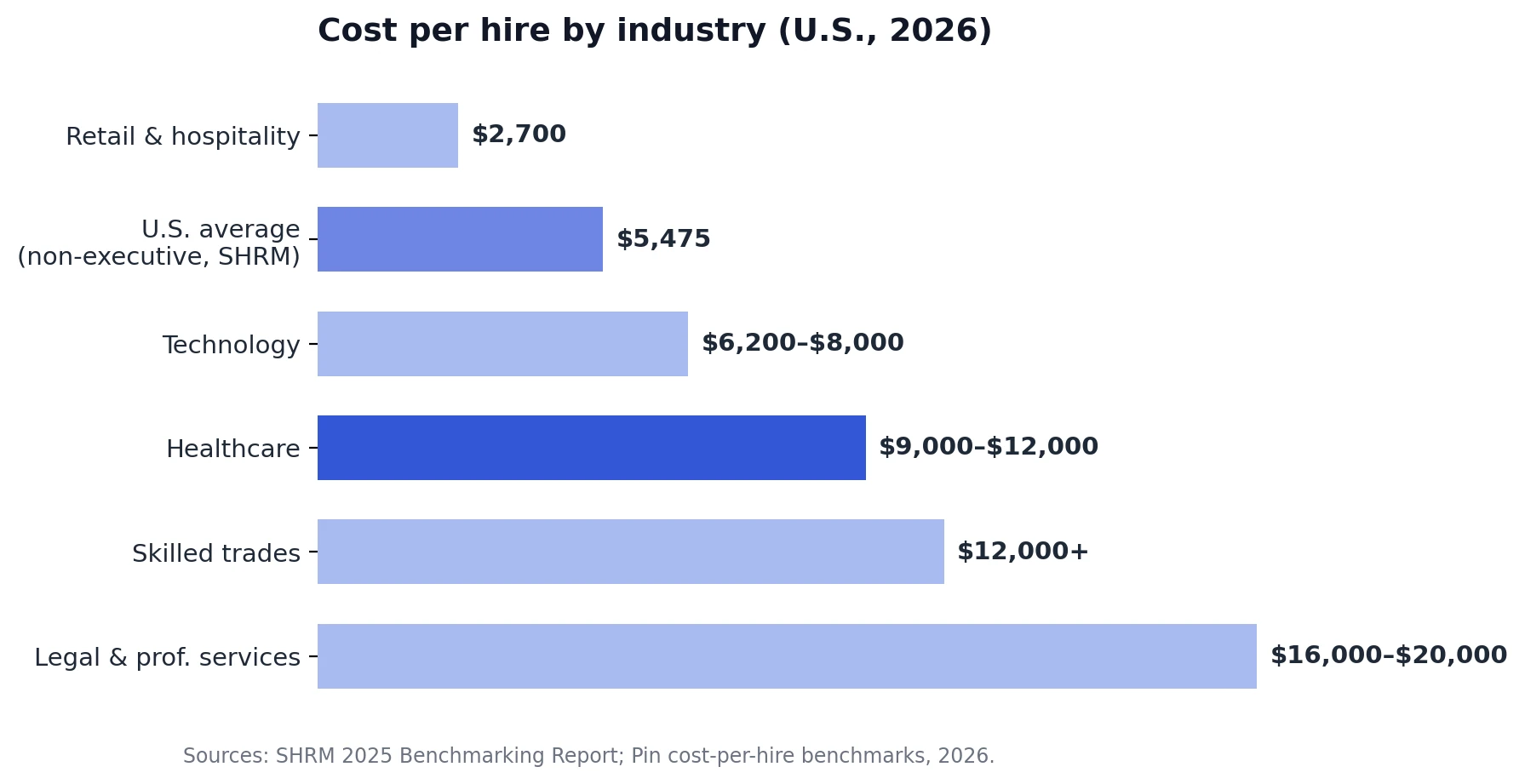
| Category | Cost per hire |
|---|---|
| U.S. average (non-executive) | $5,475 |
| Entry-level roles | $2,000–$3,000 |
| Retail & hospitality | $2,700 |
| Technology | $6,200–$8,000 |
| Healthcare | $9,000–$12,000 |
| Skilled trades | $12,000+ |
| Legal & professional services | $16,000–$20,000 |
| Executive | $28,000–$35,879 |
Sources: SHRM 2025 Benchmarking Report; Pin cost-per-hire benchmarks, 2026.
Worth knowing: these are direct-cost figures. Research from the Chartered Institute of Personnel and Development (CIPD) and the Recruitment Process Outsourcing Association (RPOA) puts the fully loaded number, with hiring-manager time and lost productivity counted, at roughly double the invoice total.
And cost per hire isn't even the expensive part in some industries. In healthcare, the vacancy is. The 2026 NSI Retention Report puts the average cost of a single RN turnover at $60,090, with experienced RN roles taking 56–102 days to fill. When the empty seat costs 6x the recruiting spend, the conclusion writes itself.
Slow-and-cheap hiring is the most expensive strategy there is.
Why is cost per hire going up?
Cost per hire is rising because job-board pricing keeps climbing, recruiter screening time keeps growing, and ghosting shrinks the hire count. In detail:
Job board economics. Pay-per-click pricing keeps rising while application quality doesn't. You're paying for clicks and applications, not interviews and not hires. When 100 applications produce 4 interviews, your cost per interview is 25x your cost per click, and nobody puts that number in the dashboard.
Recruiter time on screening. Most of the 30–40% of cost that's recruiter salary gets burned on reviewing resumes and chasing candidates who never respond. That's the "post and pray" tax.
Ghosting and no-shows. Every interview that doesn't happen and every offer that gets ghosted pushes spend onto fewer hires. Same numerator, smaller denominator.
6 ways to lower cost per hire
Applications are an input. Interviews are the first unit that predicts a hire.
- Measure cost per interview, not cost per application. Applications are an input. Interviews are the first unit that predicts a hire. Re-run last quarter's numbers as spend ÷ interviews-that-happened and you'll find out which channels are actually expensive.
- Pay flat rates instead of per-click where you can. Variable-cost channels punish volume hiring.
Flat-rate channels, including hiring events, mean your cost per hire drops as you fill more roles from
one spend.
Traditional job board
- ✕ You screen and schedule
- ✕ Weeks to fill a role
- ✕ Passive applicants
- ✕ Pay per click / per post
- ✕ Post and pray
JobFairX hiring event
- ✓ Interviews auto-scheduled
- ✓ 20–100+ interviews in one day
- ✓ Candidates who request to meet you
- ✓ Flat rate, unlimited interviews
- ✓ Message + interview before, during, and after
Job board vs. hiring event: pay per click vs. flat rate, weeks to fill vs. one interview day. - Batch interviews into events. One recruiter running back-to-back scheduled interviews for a day beats three weeks of calendar Tetris. This is the single biggest lever for high-volume hiring. Interviewer time is your largest hidden cost, and batching cuts it hard.
- Only interview people who asked to meet you. No-shows collapse when the candidate requested the
interview slot instead of being chased into it. Pre-qualified, self-scheduled interviews flip the dynamic:
candidates who picked your company and picked the time show up.
Matched candidates request interviews with your team. You accept, they show up.
- Cut your time to fill. Cost per hire and time to fill move together. Every extra week a role sits open adds recruiter hours, ad spend, and (in healthcare especially) vacancy cost that dwarfs the recruiting budget.
- Actually calculate channel ROI. Most teams can't say what a hire from each channel costs because the spend is pooled. Separate the data per channel, per quarter. Our recruiting ROI guide has the formulas and a business-case template.
What's your cost per hire?
Where do hiring events fit?
Flat-rate hiring events are one of the few channels where cost per hire falls as you hire more, because the spend is fixed while the hires aren't. Worth a straight answer, since we run them: that's the flat-rate effect from #2, and it's why events tend to win for multi-role, hourly, and clinical hiring, where interview volume is the bottleneck.
Our own 2025 numbers, from the most expensive row on the benchmarks table above: across 582 healthcare hiring events, employers averaged 35 scheduled interviews and 8 hires per event. Set that against our published pricing: even at the top flat-rate tier, the channel spend works out to under $200 per hire, before staff time — against the $9,000–$12,000 healthcare average through traditional channels.
The honest caveat: an event is not the right tool for every role. A single specialized senior hire is still a sourcing-and-outreach game. If you want the actual event math against these benchmarks, we published it on our hiring event pricing page.
“Every hiring budget I look at pays for activity: clicks, posts, applications. Almost nobody pays for interviews. But interviews are the only thing in the funnel that predicts a hire. The moment you start pricing channels in cost per interview instead of cost per click, the decision makes itself.”
FAQ
What is a good cost per hire?
Below your industry benchmark, trending down. For hourly and entry-level roles, under $3,000. Against the $5,475 U.S. average, anything under ~$2,000 is strong. But a "good" number with a 90-day time to fill isn't good. Read the two metrics together.
What should be included in cost per hire?
Everything recruiting touches: recruiter and sourcer compensation (allocated), job boards, advertising, agencies, software, background checks, referral bonuses, interviewer time, and events. SHRM's formula: total internal + external recruiting costs ÷ total hires.
Why is healthcare cost per hire so high?
Credentialing, licensure verification, a shrinking candidate pool, and competition. Healthcare hires cost $9,000–$12,000 and health services roles take the longest to fill of any industry (49 days per Workable). The vacancy cost makes it worse: NSI puts one RN turnover at $60,090.
Does cost per hire include onboarding?
Under the SHRM standard, no. It stops at the accepted offer. Some teams track "cost per productive hire" including onboarding and ramp; useful, but keep it separate so your benchmark comparisons stay apples-to-apples.